How to Get Your Shopify Store Recommended by ChatGPT (2026 GEO Guide)
A practical GEO guide for Shopify sellers: the 5 signals AI looks for, a step-by-step setup, and how to measure AI-driven traffic. No hype, no guarantees.
A growing share of your future customers won’t find you on Google. They’ll ask ChatGPT, Perplexity, or Gemini “what’s the best [your product] under $X?” — and the AI will name a handful of stores. If yours isn’t one of them, you never even enter the consideration set.
This is the problem GEO (Generative Engine Optimization) solves. This guide explains, in plain language, what GEO is, the five signals AI engines actually look for in a store, and a step-by-step way to set it up on Shopify. No jargon, no magic, and — importantly — no false promises. Nobody can guarantee an AI will recommend you. What you can do is remove the reasons it currently ignores you.
Disclosure: Some links below are affiliate links. If you subscribe through them we may earn a commission at no extra cost to you. We recommend based on what the tools do, not on commissions.
What Is GEO (Generative Engine Optimization)?
GEO is the practice of making your store easy for AI engines to understand, trust, and cite when a shopper asks them what to buy.
The mental model that helps most: SEO optimizes for a ranked list of blue links. GEO optimizes to be the answer inside a conversation. Google shows ten links and lets the user choose. ChatGPT names two or three stores and the user often stops there. Being “on page one” means nothing if the AI never mentions you.
GEO is sometimes called AEO (Answer Engine Optimization). For a store, the practical goal is the same: when an AI summarizes options in your category, your products are in the answer with accurate details.
Why GEO Matters Now (Not Next Year)
A few shifts make this urgent rather than theoretical:
- Buyers already research with AI. A large share of shoppers now consult ChatGPT, Perplexity, or Gemini before buying — especially for considered purchases.
- Google is keeping the click. AI Overviews answer questions directly on the results page, and organic click-through on affected queries has dropped meaningfully. The traffic SEO used to send you is being absorbed.
- AI referral traffic converts well. Visitors arriving from AI engines tend to be further down the decision funnel — they’ve already been “pre-sold” by the conversation — so they convert at healthy rates.
- The window is open. Most stores have done nothing here yet. Early, accurate GEO is cheap leverage while competition is light.
⚠️ Reality check: AI recommendations are non-deterministic. The same prompt can return different stores on different days. GEO improves your odds of being cited; it does not lock in a position. Treat anyone promising “guaranteed #1 on ChatGPT” as a red flag.
The 5 Signals AI Looks For in a Store
AI engines don’t rank stores the way Google does. They cite stores that give them enough verifiable, machine-readable information to recommend confidently. Five signals matter most.
1. LLMs.txt — the “Sitemap for AI”
llms.txt is a plain-text file at your domain root (yourstore.com/llms.txt) that tells AI crawlers what your store sells, who it’s for, and how your catalog is structured. Without it, models guess about your brand from partial crawl data — and guesses get you left out.
Think of it as a sitemap written for language models instead of search bots.
2. Structured Data (Product / FAQ / Review schema)
Structured data (JSON-LD) gives AI verified, parseable facts: price, materials, availability, return policy, ratings. It’s how ChatGPT can state your necklace is “18K gold, $180, ships in 2 days” without having to interpret your prose. The key schema types for a store:
Product(price, availability, brand, GTIN)Offer(pricing, currency, condition)Review/AggregateRating(social proof)FAQPage(direct answers to buyer questions)Organization(who you are)
3. Scenario-Based Content
AI cites the source that directly answers the question a shopper asked. If buyers ask “how do I care for luxury linen sheets?” and your store has the clearest answer, Perplexity and ChatGPT can cite you. If you don’t, a competitor’s blog gets the citation. Content that maps to real buyer questions — care guides, sizing help, comparisons, use-case pages — is GEO fuel.
4. Factual Density in Descriptions
Thin descriptions (“soft, comfortable, stylish”) give AI nothing to cite. Specific, factual descriptions do: “400-thread-count Italian linen, ~10% cooler than cotton, OEKO-TEX certified, ships in 2 days.” The denser and more verifiable your facts, the more confidently an AI will surface your product.
5. Third-Party Citations
External mentions — press, review sites, influencer content, reputable directories — confirm your credibility to AI models, which weight third-party corroboration heavily. A store that only talks about itself is harder to trust than one the wider web also references.
Step-by-Step: Set Up GEO on Your Shopify Store
You can do most of this yourself. Tools (next section) automate the tedious parts.
- Audit what AI currently sees. Ask ChatGPT, Perplexity, and Gemini the questions your buyers ask (“best [category] for [use case]”). Note whether you appear, whether competitors do, and whether any facts are wrong. This is your baseline.
- Publish an llms.txt file at your domain root describing your catalog and audience.
- Confirm AI crawlers aren’t blocked. Check
robots.txtisn’t excluding AI user agents you want to allow. - Add structured data (
Product,Offer,Review,FAQPage,Organization). Many Shopify themes/apps generate this. - Thicken your product descriptions with specific, verifiable facts (materials, dimensions, certifications, shipping).
- Create scenario content that answers the top buyer questions in your category (care, sizing, comparisons, “best for X”).
- Earn third-party mentions — get listed in reputable directories, pitch reviews, collaborate with credible voices.
- Re-test monthly. Re-run your baseline prompts and watch whether your presence and accuracy improve.
Tools That Automate GEO
Doing all of the above by hand is possible but slow. A category of Shopify apps now automates llms.txt, schema, FAQ generation, and AI-mention tracking. The main options, by price tier:
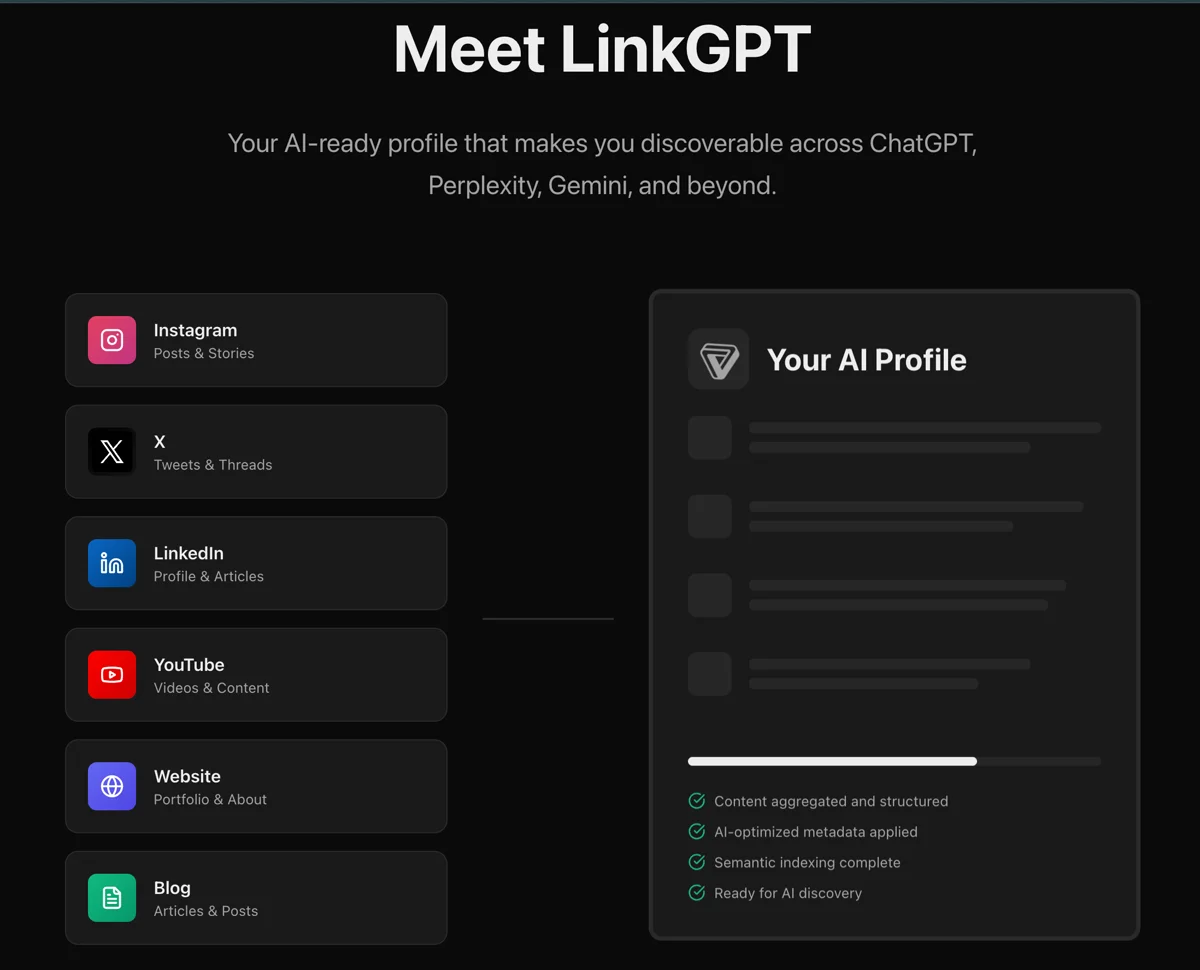
- LinkGPT — cheapest entry (~$14/mo). Generates an AI-optimized profile, llms.txt, JSON-LD, and pings AI models with catalog updates. Good for getting the basics in place fast.
- StoreRank — mid-market (~$29–$289/mo). Fuller toolkit: schema, smart FAQs, AI-article autopilot, and mention/competitor tracking across ChatGPT, Gemini, Perplexity, Claude.
- Comergent AI — enterprise (~$499–$1,599/mo). Adds revenue attribution (tags Shopify orders by AI source) and deeper content automation.
- Surfient — has a free audit tier; strong on audit + fix automation, good for SMBs who want to see gaps before paying.
We compare these head-to-head — features, pricing, and where each falls short — in our dedicated guide: Comergent vs StoreRank vs LinkGPT.
⚠️ Most of these are Shopify apps; some run referral programs via coupon codes or app-billing tracking rather than traditional cookie affiliates. Confirm terms before relying on links or coupon attribution.
How to Measure AI-Driven Traffic & Revenue
GEO is only worth doing if you can see it working. Three layers of measurement:
- Presence tracking: re-run your baseline prompts on a schedule; record whether you’re cited and whether facts are correct.
- Traffic attribution: in GA4, watch for referral/Direct traffic from
chatgpt.com,perplexity.ai, etc. (a chunk of “Direct” is often AI-referred and mislabeled). - Revenue attribution: enterprise GEO tools tag Shopify orders by AI source so you can see dollars, not just sessions.
Start with presence + GA4 — they’re free. Add revenue attribution only when volume justifies the cost.
Common GEO Myths
- “You can guarantee a #1 spot on ChatGPT.” No. Citations are non-deterministic; anyone guaranteeing a position is misleading you.
- “GEO replaces SEO.” No. Good SEO foundations (clean site, schema, authority) feed GEO. They’re complementary.
- “More content always helps.” Only accurate, scenario-matched content helps. Thin, duplicative pages can hurt.
- “It’s a one-time setup.” No. AI search rules change frequently; GEO needs maintenance (which is also why staying current is an advantage).
Bottom Line
GEO isn’t magic and it isn’t guaranteed — but the work is concrete: publish an llms.txt, add structured data, write factual scenario content, and earn outside mentions. Stores that do this become the answer when shoppers ask AI what to buy. Stores that don’t stay invisible in the fastest-growing discovery channel of 2026.
Start with the free audit: ask ChatGPT, Perplexity, and Gemini the questions your buyers ask, and see whether you show up. Whatever’s missing is your roadmap.
Last updated: 2026-06. GEO changes fast — we re-verify and update this guide quarterly.
FAQ
What is GEO for Shopify?
GEO is making your Shopify store easy for AI engines like ChatGPT, Perplexity, and Gemini to understand, trust, and cite when shoppers ask what to buy.
Can I guarantee ChatGPT recommends my store?
No. AI recommendations vary by prompt and over time. GEO improves your odds by improving clarity, crawlability, structured data, and third-party proof.
What is an llms.txt file?
A plain-text file at your domain root that tells AI crawlers what your store sells and how it is structured.
Do I need a paid tool for GEO?
No. You can publish llms.txt, add schema, and improve descriptions yourself. Paid Shopify apps automate the work and add tracking.
How long until GEO works?
It varies. Treat it as ongoing: set a baseline, improve the five signals, and re-test monthly.